
How Wide Is a Living Branch
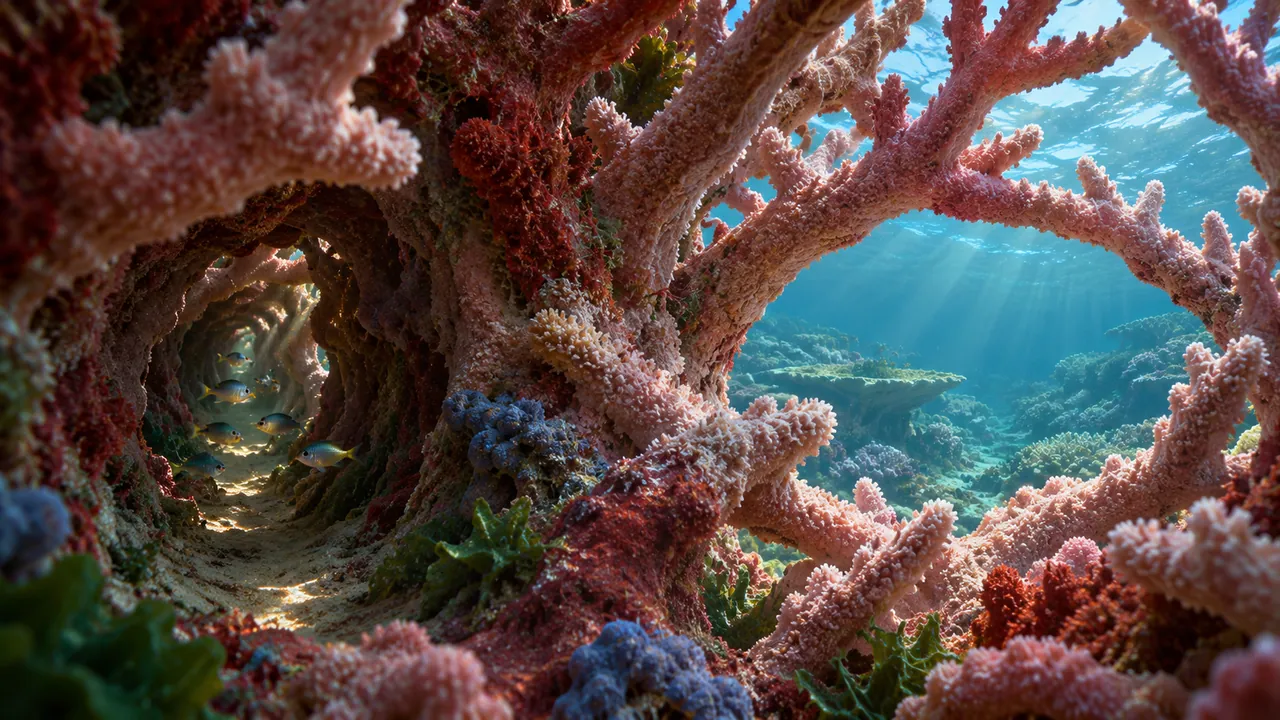
The opening inside the older reef seemed bigger than the opening near the white garden because the older branches had stronger edges. A still frame taken from above made the two spaces even harder to compare. The design uses small fish at both openings so the size of each passage can be read in relation to something that actually travels through it. The fish in the shaded interior turn before reaching the branch. The fish in the external channel pass beside a different edge. Watching the difference in their route gives the player a way to judge each opening from a useful working position.
Start at the smaller opening
Put the viewpoint at the front shelf and look for the part of the dark branch where the shadow stops abruptly. A narrow gap lies around the back of it. The school can turn into that gap without taking up the entire visible height of the opening. As you move to the lower side, the fish become visible sooner. A broad part of the near branch casts a shadow across the upper half of the passage. A small colored edge outside that shadow distinguishes two overlapping forms. The gap belongs to the physical branches, even though it is easier to see from the lower working position.
Compare the outer route
The neighboring passage has wide sides that catch light and an almost bare top. A single fish can look small beside it. When several fish turn at once, part of the group crosses the current outside the shade. We use that fact to demonstrate why a broad path can be harder for the school to follow. The guardian may still use it if the slower opening has become occupied by another guide. An area behind the outer branch gives the player enough room to compare those two choices. From that location, it is clear where the corridor has no cover at all and where the group can hold itself briefly.
Check what changes if cover returns
In the garden scenario, a preview marks edges of proposed new cover. The deeper part of the suggested branch can conceal a useful opening if it is placed too low. Before applying the change, compare two locations in the same clear water. The markers stay visible at the edge of each shadow so you can see where the earlier shape lived. We show a small shaded area that could connect the two pockets. Compare where a fish could turn in that area with where it would turn in front of the existing branch. The useful change can be subtle because it may require a shorter rather than a wider crossing.
Restore a meaningful comparison after a move
White Branch Garden uses the size and direction of usable openings to make placement choices. A Tile at the Garden Edge follows the same change from the other side of the bed. Nursery Fork isolates the earlier decision to use a dark nursery pocket as a place for the school to gather. In our next design comparison we will retain one opening and move the closest branch above the other. The angle will change even if the size of the gap hardly does. We want someone looking from the front shelf to choose the other ledge when that angle makes shelter hard to read, and to identify what part of the school they need to see there.
Place the first observation point just inside the ledge. The short swim from there to its outer end gives the viewer a predictable change in perspective. Look for the moment at which the white branch conceals the dark edge behind it, then compare the space above and below the edge.